
The way people search online is changing rapidly. Instead of typing simple keywords into a search engine, users now expect intelligent, conversational answers. This shift has sparked AI search optimization, which is transforming how people discover, rank, and consume content. As a result, businesses and marketers must rethink their strategies to stay visible.
In this guide, we’ll cover what you need to know about AI search optimization. We’ll explain how it works. We’ll also show how to adapt your digital strategy.
What is AI Search and How Does It Work?
At its core, AI search means search systems powered by artificial intelligence tools. These include natural language processing (NLP), machine learning, and deep learning. Unlike traditional keyword-based search, AI-driven systems understand context, intent, and user behavior.
For instance, instead of matching exact keywords, AI analyzes the meaning behind a query. As a result, it delivers more personalized and conversational results. This is particularly useful for voice searches and chat-based queries, where users phrase questions naturally.
Moreover, AI systems constantly learn from user interactions. Over time, they refine their responses, making search experiences more accurate and intuitive. Consequently, businesses must adapt their content to align with these smarter algorithms.
How Does AI Search Work
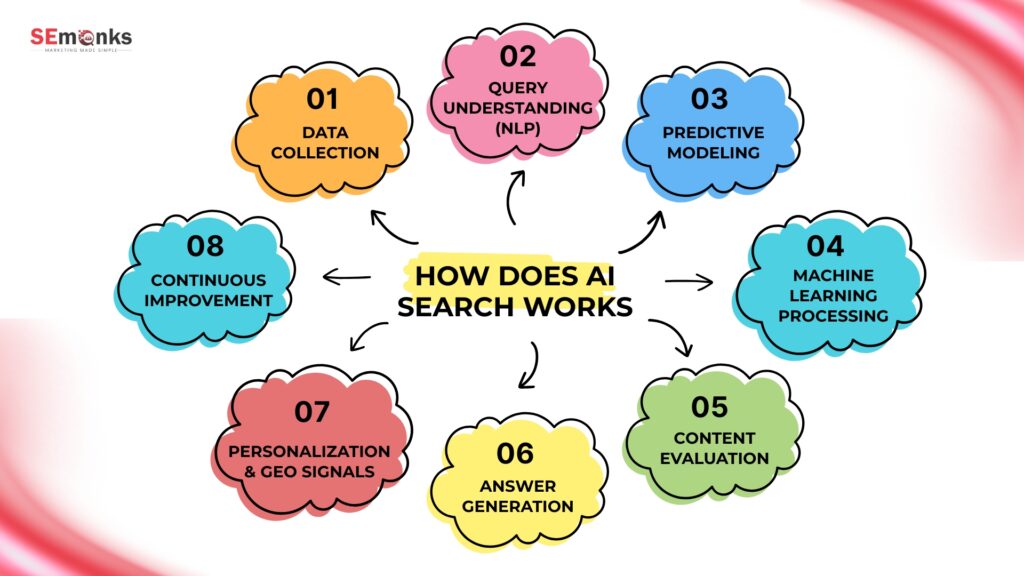
- Data Collection:
AI systems gather large volumes of data from websites, user interactions, and search history to understand patterns. - Query Understanding (NLP):
Using natural language processing, AI search understands a user’s intent, context, and meaning. It does not just match keywords. - Predictive Modeling:
It identifies what the user actually wants—information, navigation, or a transaction—making results more relevant. - Machine Learning Processing:
Algorithms analyze past behavior and constantly learn to improve the accuracy of responses over time. - Content Evaluation:
The system evaluates content quality, authority, and relevance rather than relying only on keyword density like traditional SEO. - Answer Generation:
With the help of AEO, AI can generate direct, concise answers instead of just listing links. - Personalization & GEO Signals:
Results are tailored based on user location, preferences, and behavior, where GEO plays a key role. - Continuous Improvement:
AI keeps refining its results by learning from user engagement, clicks, and feedback.
These steps show how AI search delivers smarter, faster, and more personalized search experiences.
The Major AI Search Platforms
Several platforms are leading the evolution of AI-driven search. These include:
- Google’s AI-powered search features, such as Search Generative Experience (SGE)
- Microsoft Bing with AI integrations
- Chat-based tools like conversational AI assistants
- Voice assistants like Alexa and Google Assistant
Each platform uses AI differently, but the goal remains the same: delivering faster, more relevant answers.
As these platforms evolve, traditional SEO techniques alone are no longer enough. Instead, marketers must combine SEO with AEO strategies to ensure their content is observable in AI-generated responses.
How AI Search Affects SEO (and What You Can Do)
The rise of AI is significantly reshaping SEO. Previously, ranking high on search engine results pages was the primary goal. However, with AI-driven answers appearing directly on search pages, users may not even click on links.
Therefore, businesses must shift their focus. Instead of just ranking, the aim should be to become the source of information that AI systems pull from.
To adapt effectively:
- Create high-quality, informative content
- Use structured data and schema markup
- Focus on user intent rather than just keywords
- Optimize for conversational queries
Furthermore, integrating GEO strategies can enhance visibility in location-based results. At the same time, adopting AEO ensures you optimize your content for answer-based results.
Companies like SEmonks are already helping businesses transition into this new era by combining traditional and AI-focused strategies.
Traditional SEO vs AI Search Optimization
| Aspect | Traditional SEO | AI Search Optimization |
| Focus | Keyword-based ranking | User intent and context understanding |
| Content Style | Optimized for search engines | Conversational and human-like content |
| Goal | Drive clicks and traffic | Provide direct answers and solutions |
| Techniques Used | Backlinks, keywords, technical SEO | AEO, structured data, semantic relevance |
| User Experience | Search → Click → Read | Instant answers within search interface |
This simplifies the shift in strategies from conventional SEO methods toward more advanced, AI-powered, intent-driven approaches.
How to Optimize AI Search
Optimizing for AI-driven platforms requires a strategic approach. Foremost, write content in a natural, conversational tone. This aligns with how users interact with AI systems.
Next, focus on answering specific questions clearly. Use headings, bullet points, and concise explanations. This increases your chances that AI-generated responses will feature you.
Additionally:
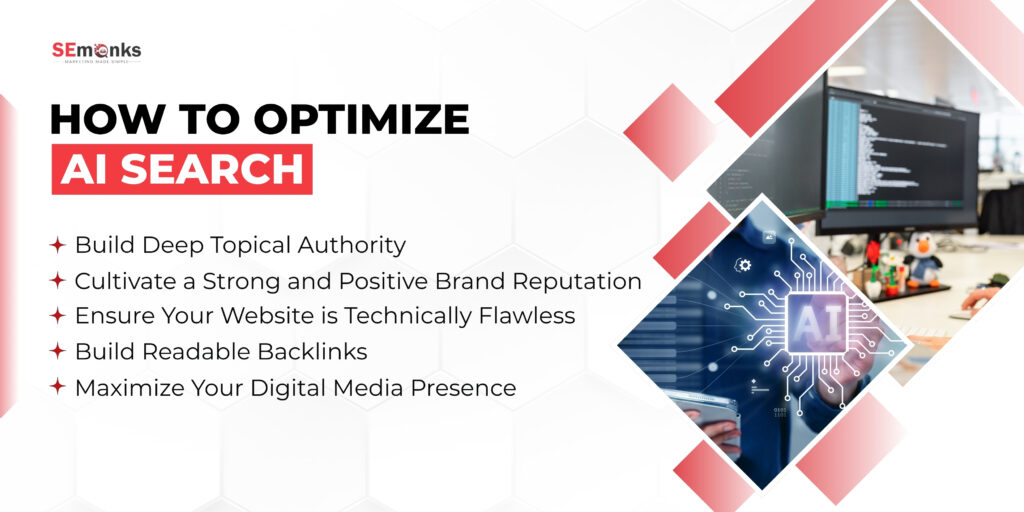
- Build Deep Topical Authority
- Cultivate a Strong and Positive Brand Reputation
- Ensure Your Website is Technically Flawless
- Build Readable Backlinks
- Maximize Your Digital Media Presence
At the same time, combining AEO and GEO strategies ensures your content is both answer-focused and location-relevant.
Partnering with experts like SEmonks can make this process smoother. They align content with modern AI search trends.
How to Measure AI Search Visibility
Measuring performance in AI-driven search environments can be challenging. Unlike traditional analytics, clicks and impressions are not the only metrics that matter.
Instead, consider the following:
- Featured snippet appearances
- Inclusion in AI-generated answers
- Brand mentions in conversational results
- Engagement metrics such as time on page
Moreover, tracking tools are evolving to accommodate AI search insights. Businesses should also track how often AI systems use their content as a reference.
By combining these metrics with traditional SEO analytics, you can gain a more comprehensive view of your visibility.
AI and the Future of SEO: The Evolution Changes
Looking ahead, the integration of AI into search will only deepen. Search engines will become more conversational, predictive, and personalized.
As a result, the role of SEO will continue to evolve. Instead of focusing solely on rankings, the emphasis will shift toward providing value-driven, user-centric content.
Furthermore, AEO will become a standard practice, as answer-based results dominate search experiences. Similarly, GEO will play a larger role in delivering hyper-localized content.
Businesses that adapt early will have a significant advantage. Agencies like SEmonks are already preparing for this shift by blending innovation with proven strategies.
FAQs
1. What is the difference between AI search and traditional search?
AI search focuses on understanding user intent and context, while traditional search relies more on keyword matching.
2. Why is Answer Engine Optimization (AEO) important for SEO?
AEO optimizes content for direct answers and increases the chances that AI-generated results feature it.
3. How does GEO impact search visibility?
GEO ensures that content is relevant to specific locations, improving visibility for local and region-based queries.
4. Does traditional SEO still work in the age of AI search?
Yes, but you need to combine it with modern techniques like AEO and user intent optimization.
5. How can businesses optimize their websites for AI-driven search?
They should focus on high-quality content, structured data, and conversational keyword strategies.
Conclusion
The digital landscape is evolving faster than ever, and businesses must keep up with these changes to remain competitive. Embracing AI search optimization is no longer optional—it’s essential for future success. By understanding the dynamics of SEO vs AEO vs GEO and integrating these strategies with traditional SEO, brands can ensure long-term visibility and relevance.
Ultimately, adapting to this transformation requires both expertise and innovation. This is where professional support becomes valuable.

