
Pest Control SEO Content Strategy: The Foundation for Predictable Organic Leads
A Pest Control SEO Content Strategy is the backbone of sustainable lead generation. Instead of relying solely on paid ads or seasonal promotions, pest control companies can build long-term visibility through search engines.
Homeowners usually search online when they notice termites, rodents, or ants. Therefore, showing up at that critical moment increases the chance of immediate calls. However, ranking alone is not enough. The content must address urgency, safety concerns, pricing transparency, and service reliability.
Moreover, combining local seo for pest control with service-specific landing pages ensures visibility in both map listings and organic results. When implemented correctly, seo for pest control turns search traffic into scheduled inspections and recurring service contracts.
Agencies like SEmonks often emphasize that strategic planning, rather than random blogging, creates measurable growth. As a result, businesses gain steady inquiries instead of unpredictable traffic spikes.
Why Traditional Pest Control SEO Fails (And What Actually Drives Conversions)
Many companies invest in SEO but fail to see results. Why? Because traditional seo for pest control often focuses only on rankings, not conversions.
For instance, some websites publish generic blogs without targeting buyer intent. Although traffic may increase, it rarely converts into booked jobs. On the other hand, a focused Pest Control SEO Content Strategy prioritizes keywords tied to immediate problems, such as “emergency termite removal” or “same-day rodent control.”
Additionally, outdated tactics like keyword stuffing or duplicate city pages can hurt performance. Instead, modern local seo for pest control depends on authoritative content, optimized Google Business Profiles, and location-specific proof such as reviews and case studies.
Consequently, what actually drives conversions is clarity. Customers want fast answers, transparent pricing, trust signals, and easy contact options. Therefore, SEO must align with customer urgency.
Ways to Build a Revenue-Driven Content Plan for Local Pest Control Services
A strong Pest Control SEO Content Strategy should always connect content creation to revenue. Below are actionable components that consistently generate qualified leads.
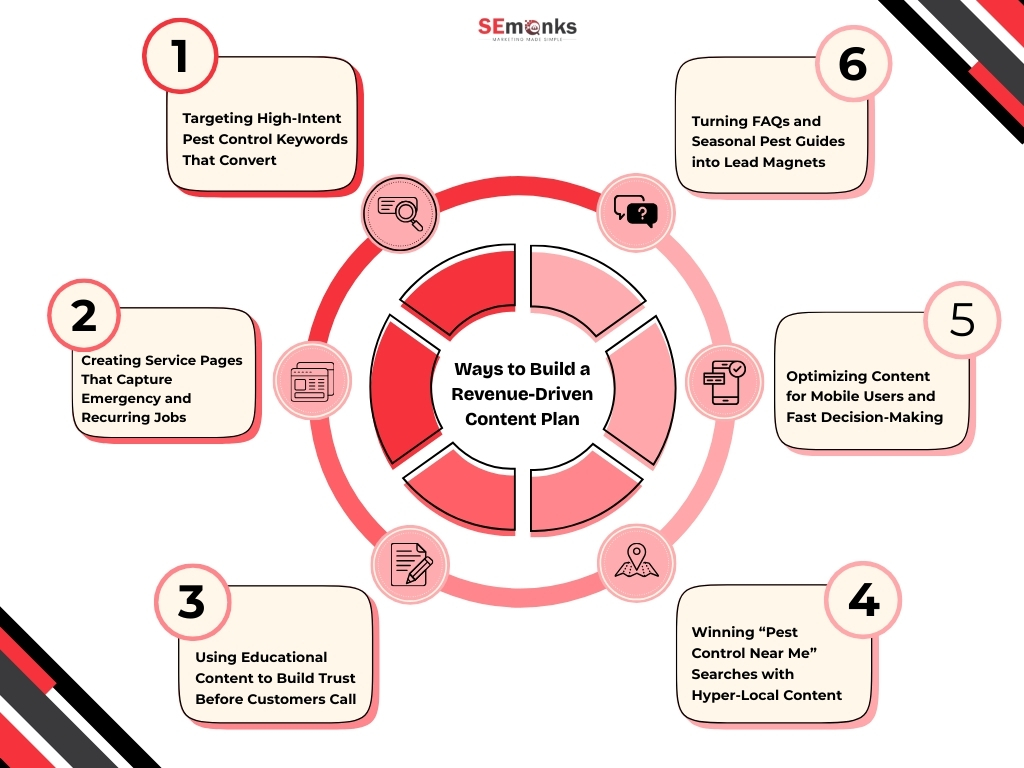
a. Targeting High-Intent Pest Control Keywords That Convert
High-intent keywords signal readiness to hire. For example:
- Bed bug exterminator near me
- Emergency wasp removal
- Affordable termite inspection
Because these phrases indicate urgency, they convert better than informational searches. Therefore, integrating them naturally into your seo for pest control efforts ensures traffic with purchasing intent.
Additionally, aligning keyword research with local seo for pest control helps capture nearby customers who are ready to act immediately.
b. Creating Service Pages That Capture Emergency and Recurring Jobs
Dedicated service pages improve both clarity and conversions. Instead of listing all services on one page, create separate pages for:
- Termite control
- Rodent removal
- Ant extermination
- Commercial pest management
As a result, search engines better understand your expertise. Meanwhile, customers quickly find solutions.
A properly structured Pest Control SEO Content Strategy includes strong calls to action, trust badges, service guarantees, and visible phone numbers. This approach not only improves visibility but also increases call volume.
c. Using Educational Content to Build Trust Before Customers Call
Not all users are ready to hire immediately. Some want to research first. Therefore, educational blogs and guides help nurture trust.
Topics may include:
- Signs of termite damage
- How to prevent rodents in winter
- Are pest control chemicals safe for pets?
By addressing concerns, you position your company as an authority. Furthermore, combining education with local seo for pest control increases visibility for long-tail searches.
SEmonks frequently highlight that educational authority significantly improves conversion rates over time. Consequently, trust becomes a competitive advantage.
d. Winning “Pest Control Near Me” Searches with Hyper-Local Content
“Near me” searches are high-converting. However, ranking requires more than adding city names.
A smart Pest Control SEO Content Strategy includes:
- City-specific landing pages
- Neighborhood case studies
- Local testimonials
- Embedded Google Maps
Moreover, optimized Google Business Profiles strengthen local seo for pest control performance. When paired with structured data and consistent NAP details, visibility improves dramatically.
Therefore, hyper-local relevance often outperforms generic statewide targeting.
e. Optimizing Content for Mobile Users and Fast Decision-Making
Most emergency searches happen on mobile devices. Consequently, fast-loading pages, click-to-call buttons, and concise messaging are critical.
While desktop users may browse longer, mobile users act quickly. Thus, your seo for pest control must prioritize page speed, readable formatting, and instant contact options.
In addition, a mobile-friendly design supports the broader goals of your Pest Control SEO Content Strategy, especially when customers need immediate assistance.
f. Turning FAQs and Seasonal Pest Guides into Lead Magnets
Frequently asked questions answer objections before customers call. For example:
- How much does termite treatment cost?
- How long does pest control treatment last?
- Is pest control safe for children?
When structured properly, FAQs enhance search visibility and user experience. Furthermore, seasonal pest guides—such as summer mosquito prevention or winter rodent control—capture recurring interest throughout the year.
SEmonks often recommends converting high-traffic guides into downloadable checklists. As a result, companies collect emails and nurture long-term prospects.
Why Content Strategy Matters More Than Rankings for Pest Control Lead Generation
Although rankings are important, revenue matters more. A #1 ranking that generates no calls has little value. Instead, a conversion-driven Pest Control SEO Content Strategy aligns messaging, structure, and intent. Moreover, integrating seo for pest control with persuasive copy and strong CTAs transforms traffic into booked jobs.
In other words, strategy connects visibility with profitability. That is why many growing pest control brands focus on content experience rather than vanity metrics.
Pest Control SEO Content Strategy: Key Takeaways for Sustainable Growth
In conclusion, pest control companies should focus on targeting high-intent, local keywords, building dedicated service and city-specific pages, prioritizing mobile usability, publishing trust-building educational content, and consistently tracking ROI. When these elements align strategically, a Pest Control SEO Content Strategy transforms into a scalable and predictable lead-generation engine. Moreover, investing in strong local seo for pest control allows businesses to dominate competitive service areas, attract ready-to-convert customers, and gradually reduce dependence on paid advertising. As a result, companies can achieve more stable monthly revenue and sustainable long-term growth.
Frequently Asked Questions About Pest Control SEO
1. What is the main goal of pest control SEO?
The main goal is to generate qualified local leads through organic search visibility and conversion-optimized content.
2. How long does local SEO take for pest control companies?
Typically, local seo for pest control takes 3–6 months to show measurable results. However, competition and content quality influence timelines.
3. Is blogging necessary for pest control SEO?
Yes. Blogging strengthens topical authority and supports internal linking strategies within your Pest Control SEO Content Strategy.
4. How do I measure success in SEO for pest control?
Track calls, booked appointments, form submissions, and revenue—not just keyword rankings.
5. Should I hire an agency for pest control SEO?
Working with specialists like SEmonks can accelerate results because they combine technical expertise, local optimization, and conversion-focused content development.

